Calls for Proposals 2011 and 2012 - Medicine and Energy come to the fore
The national funding program Nano-Tera.ch will launch 18 new collaborative research projects, uniting teams right across Switzerland. The theme of health features strongly among the research subjects selected, with strong participation from university hospitals and doctors. For the first time the theme of energy is also taking pride of place. These projects were selected by a panel of experts of the Swiss National Science Foundation (SNSF), and will begin in 2013 for a duration of four years. With an average budget of almost CHF 5.2 million, they will be funded at 45% by Nano-Tera.ch, the rest of the budget being provided by the participating institutions. As with previous calls for proposals, the key domains of Nano-Tera.ch (Bioengineering and Electronics) are well represented in the 2012 selection. What is new is the arrival of research topics combining engineering with life sciences, medicine and energy. Hospitals and doctors at the service of technology
If it is true that the giants of Swiss research - the Federal Institutes of Technology and the Universities - provide the big players in Nano-Tera.ch, nevertheless the university hospitals and the specialists that thrive there, such as specialized surgeons, neurologists and cardiologists, are taking an ever greater part in the program. These specialists represent 14% of the co-investigators for the newly accepted projects. The CHUV, the InselSpital of Bern, the University Children's Hospital in Zurich and the Hospitals of Schaffhausen will all be bringing the benefit of their expertise to the research of the Nano-Tera program. Among the themes to be explored will be portable sensors for the effective monitoring of obesity, the refinement of spinal cord repair techniques using components that combine CMOS and polymers - allowing victims of paraplegia to recover partial mobility, and a study of the use of superparamagnetic nanoparticles for the treatment of various forms of cancer. These projects require strong collaboration between medics and scientific researchers. A crucial matter: the management of energy
The theme of energy has taken on a whole new dimension in Nano-Tera.ch this year. In the past, the research being funded related mostly to ultra-low power microchip or systems. However, crucial problems such as the intelligent management of energy and the production of renewable energy will now feature in the program. For example, scientists will apply themselves to the task of producing hydrogen from water and sunlight, or managing a smart power grid, using the EPFL campus as a testing ground. The success of Nano-Tera.ch in numbers Analysis of the projects accepted by the Swiss National Science Foundation clearly shows the success of the Nano-Tera.ch program. The excellent geographical spread across Switzerland of the 111 research partners (see below) shows its country-wide participation while the distribution by discipline and by institution, clearly underlines the collaborative and multidisciplinary character of Nano-Tera.ch. Also noteworthy is the presence of 16 industrial partners with the 18 projects accepted.
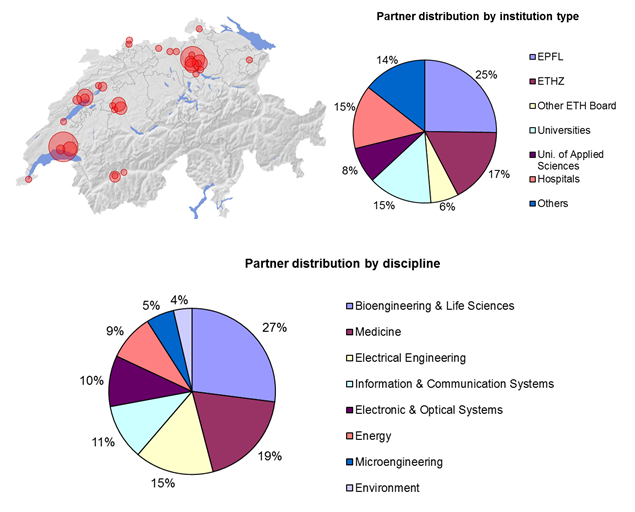
"With an average of 6 partners per project from a variety of institutions and disciplines, the scientists will be able to collaborate at all levels right up to the final prototype," stated Martin Rajman, Director of Nano-Tera.ch. "This diversity, combined with research themes which are strongly oriented towards concrete applications in the key domains of health, the environment and energy, are the hallmark of the program and the best guarantee for its success. All in all, we have many reasons to be highly satisfied with these recent developments!"
| Project Name | Principal Investigator | Institutions Involved |
|---|
| High performance portable 3D ultrasound platform | Giovanni De Micheli (EPFL) | EPFL, ETHZ, CHUV |
| A multi-component sensor for air pollutants and greenhouse gases | Jérôme Faist (ETHZ) | ETHZ, EMPA, UniNE, FHNW |
| Wearable ICT for Zero Power medical Applications | Pierre-André Farine (EPFL) | EPFL, ETHZ, CHUV, Kinderspital ZH |
| Wise Skin for tactile prosthetics | John Farserotu (CSEM) | CSEM, EPFL, BFH |
| Therapeutic drug monitoring for Personalized medicine | Carlotta Guiducci (EPFL) | EPFL, CHUV, HES-SO |
| From Superparamagnetic Nano-particles until Tools for Detection and Treatment of cancer | Heinrich Hofmann (EPFL) | EPFL, ETHZ, UniGE, UniZH, CHUV, InselSpital |
| Multi Functional Wearable Wireless Medical Monitoring Based on A Multi Channel Data Acquisition and Communication Management System on a Chip | Qiuting Huang (ETHZ) | ETHZ, UniZH, UniSpital ZH, REMSMED, ACP |
| Smart grids, Smart buildings and Smart sensors for Optimized and Secure Management of Electricity Distribution using dedicated microelectronic ICs and real time ICT | Maher Kayal (EPFL) | EPFL, HES-SO |
| Novel semiconductor disk lasers for biomedical and metrology applications | Ursula Keller (ETHZ) | ETHZ, UniNE, ABB, METAS |
| Hybrid CMOS-polymer neural interfaces for restoration of sensorimotor functions after spinal cord injury | Stéphanie Lacour (EPFL) | EPFL, ETHZ, CSEM |
| Demand Response for Ancillary Services: Thermal Storage Control | John Lygeros (ETHZ) | ETHZ, UniSG, EMPA, SwissGrid |
| Solar Hydrogen Integrated Nano Electrolysis | Christophe Moser (EPFL) | EPFL, EMPA, CSEM |
| Smart muscles for incontinence treatment | Bert Müller (UniBas) | UniBas, UniBE, EMPA, InselSpital, Spitär SH |
| Wearable MRI detector and sensor arrays | Klaas Prüssmann (ETHZ) | ETHZ |
| MEMS acoustic detectors for natural hazard warning systems | Lothar Thiele (ETHZ) | ETHZ, UniZH, FOEN |
| Monitoring the Consequences of Obesity | Jean-Philippe Thiran (EPFL) | EPFL, EMPA, BFH, CHUV, CSEM, UniSpital ZH, CRR-SUVA |
| Automated surveying of surface water quality by a physical, chemical and biological sensor equipped anguilliform robot | Jan van der Meer (UNIL) | UNIL, EPFL, HES-SO, Eawag |
| Image-guided micro surgery for hearing aid implantation | Stefan Weber (UniBE) | UniBE, BFH, CSEM, InselSpital |
You can find other news stories here.
|